

Four months in, and suddenly everyone's talking about peanut.
When to start introducing allergens, how to tell if your baby's ready, and how to keep it going without overthinking it.
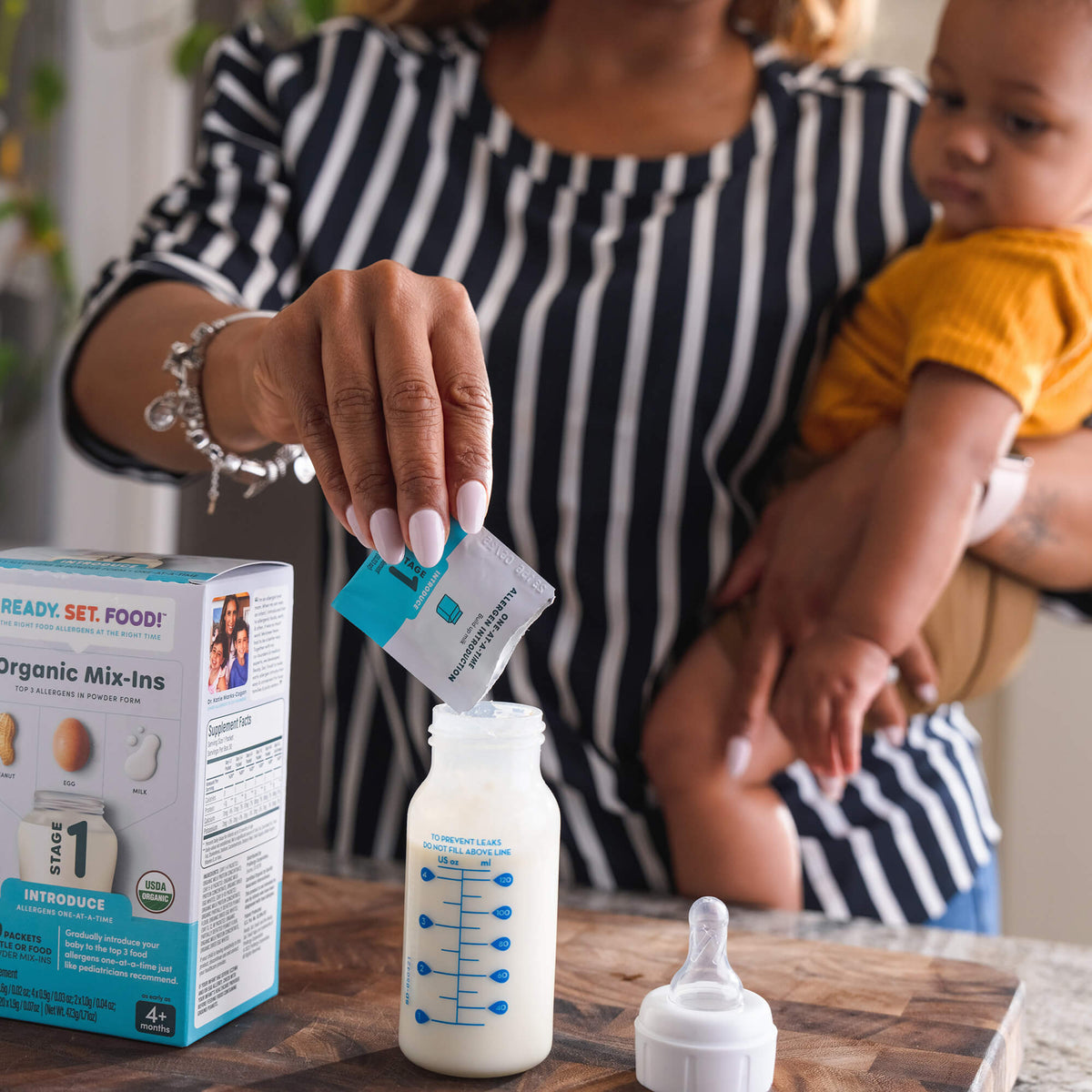
If you grew up hearing "wait until they're older" about peanut and egg, you're not alone. That was the advice for years. It's not the advice anymore.
Today, pediatric guidelines encourage introducing allergens early, often right alongside your baby's first foods. For a lot of babies, that window opens somewhere between 4 and 6 months. Here's what that actually means, and how to start.
What do the guidelines say about introducing allergens early?
Short version: start early, keep it regular, and don't start before 4 months. A few of the big ones:
- NIAID (2017). For babies with severe eczema, egg allergy, or both, peanut foods can start as early as 4 to 6 months, after a talk with your doctor. Mild to moderate eczema: around 6 months. No eczema or food allergy: introduce freely once solids begin.
- American Academy of Pediatrics (2019). No evidence that holding off on common allergens past 4 to 6 months helps, and early introduction may be beneficial.
- Dietary Guidelines for Americans (2020–2025). Introduce allergenic foods along with other first foods, instead of saving them for later.
If your baby has severe eczema or a known food allergy, check with your pediatrician before you start. They may want to see your baby first.
Is your baby ready? Signs to look for at 4–6 months
The calendar is only half of it. Allergen introduction usually lines up with readiness for solids, so watch your baby, not just the date. Most babies are ready when they:
- Hold their head steady and upright
- Sit up with some support
- Watch you eat, or reach for your plate
- Open up when a spoon comes close
- Swallow food instead of pushing it back out with their tongue
Some babies get there at 4 months. Some take until closer to 6. Both are completely normal.

How to start introducing allergens
- Loop in your pediatrician. Especially if there's eczema or a known allergy in the picture.
- Pick a healthy day. Skip days when your baby is sick or extra fussy, so you can tell how they're really doing.
- One new allergen at a time. If something does come up, you'll know what caused it.
- Start small. A little bit mixed into something your baby already takes, like breast milk, formula, or a puree.
- Go early in the day. Morning or early afternoon gives you a couple of hours to keep an eye on things.
- Make it easy to swallow. No whole nuts, and no spoonfuls of thick nut butter. Thin it with water or puree, or use a powder made for babies.
- Keep it going. Once a food is in, keep offering it regularly. The routine matters as much as the first taste.


Which allergens should you introduce?
The FDA recognizes nine major food allergens:
Peanut, egg, milk, wheat, soy, tree nuts, fish, shellfish, sesame.
| Allergen | Easy ways to offer it |
|---|---|
| Peanut | Peanut butter thinned with water or puree, peanut powder |
| Egg | Well-cooked egg, mashed or mixed into puree |
| Milk | Yogurt, cheese (cow's milk as a drink waits until 12 months) |
| Wheat | Infant wheat cereal, soft pasta |
| Soy | Tofu, soy yogurt |
| Tree nuts | Thinned nut butters, nut powders |
| Fish | Flaked, well-cooked fish |
| Shellfish | Finely minced, well-cooked shrimp |
| Sesame | Tahini, thinned into puree |
Peanut and egg have the most research behind early introduction, so a lot of parents start there. Whatever order you go in, the goal is variety and consistency. One taste isn't enough.

Want a simpler way to keep it going?
Here's the part nobody tells you: introducing allergens is easy for a week. Doing it consistently for months, between naps, feeds, and everything else, is the hard part. That's where early allergen introduction products can help.
If you're comparing allergen introduction kits, look for something that mixes into what your baby already eats or drinks, has infant-safe textures, gives you a clear plan for how much and how often, and keeps the ingredients simple.
Start here at 4 months
Stage 1 + 2 Mix-Ins
From $148.75 · free shipping
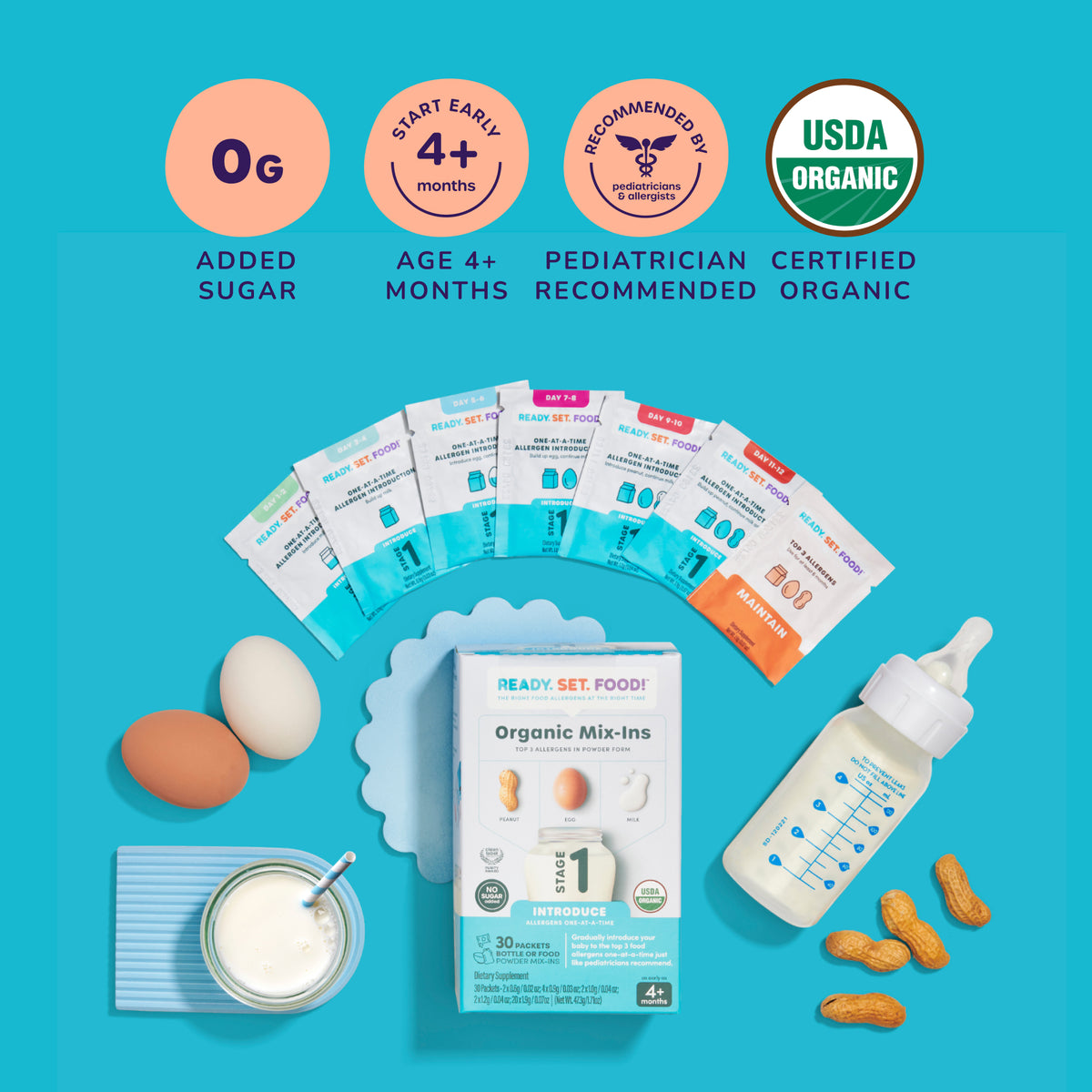
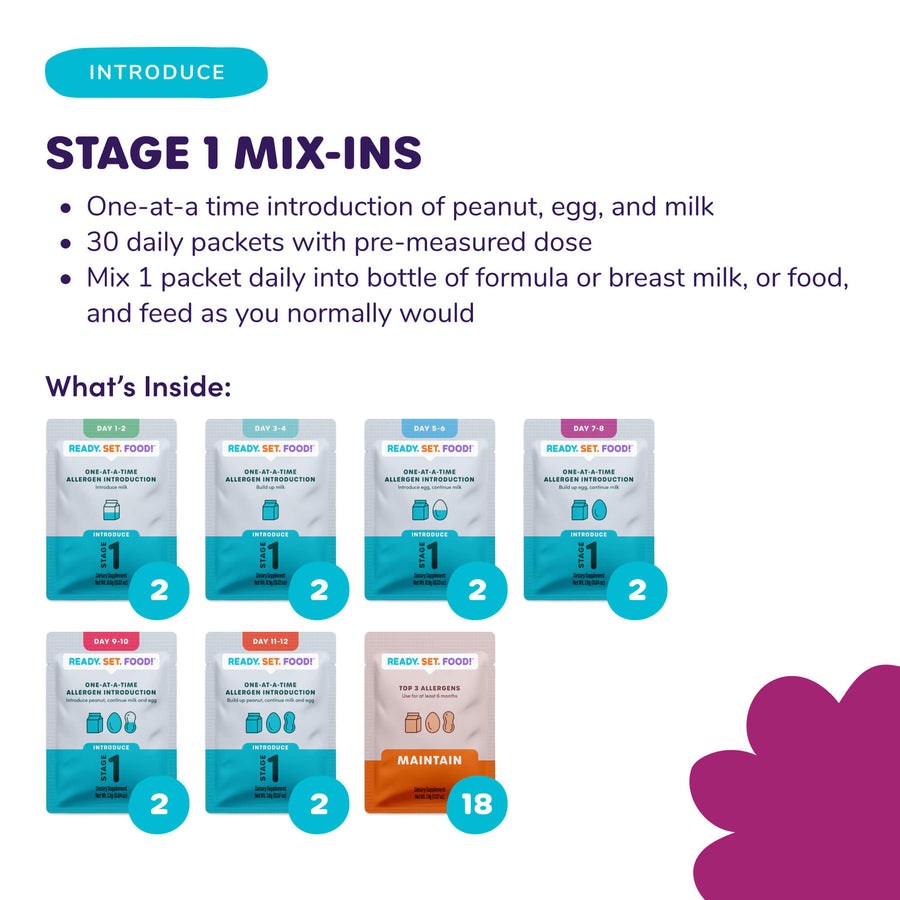
Introduces peanut, egg, and milk one at a time over the first 30 days, then keeps them going. Pre-measured daily packets mix into breast milk, formula, or food. Organic, no added sugar.
Shop Stage 1 + 2 Mix-Ins
Signs of an allergic reaction, and when to get help
Most babies take new foods in stride. Still, it's good to know what to look for. Reactions usually show up within minutes to two hours.
Call your pediatrician if you see
- A few hives or a rash around the mouth or face
- Mild vomiting or an upset tummy
Call 911 right away if your baby has
- Trouble breathing, wheezing, or repeated coughing
- Swelling of the lips, tongue, or face
- Hives all over, along with other symptoms
- Repeated vomiting, or seems unusually pale, floppy, or drowsy
If your baby reacts to a food, stop offering it and talk to your pediatrician before trying again.
Introducing allergens at 4 months: FAQ
Can I start introducing allergens at 4 months?For many babies, yes, as long as they're showing signs they're ready for solids. Guidelines generally point to 4 to 6 months, and not before 4 months. Check with your pediatrician first, especially if your baby has eczema.
Is it better to introduce allergens early or wait?Current AAP and NIAID guidance recommends introducing allergens early rather than delaying. Waiting until after the first year is no longer advised.
What are the 5 major allergens?You'll still see "5 major allergens" in older articles, but the FDA now recognizes nine: peanut, egg, milk, wheat, soy, tree nuts, fish, shellfish, and sesame.
How often should my baby have allergens after the first try?Regularly. Once a food is introduced and tolerated, keep it in your baby's diet several times a week. Your pediatrician can tell you what's right for your baby.
Do I need an allergen introduction kit?No. You can do this with everyday foods. A kit just makes it easier to stay consistent without the prep.


Feel a little more ready
Starting is one step. Keeping allergens in the routine is the part that counts. If you'd like the plan mapped out for you, Stage 1 + 2 Mix-Ins cover the first introduction and the months that follow.
Keep the routine going
Stage 1 + 2 Mix-Ins
2-, 3- or 6-month programs · free shipping
Stage 1 introduces peanut, egg, and milk one at a time. Stage 2 keeps them in your baby's routine. Start as early as 4 months.
Shop Stage 1 + 2 Mix-Ins


